


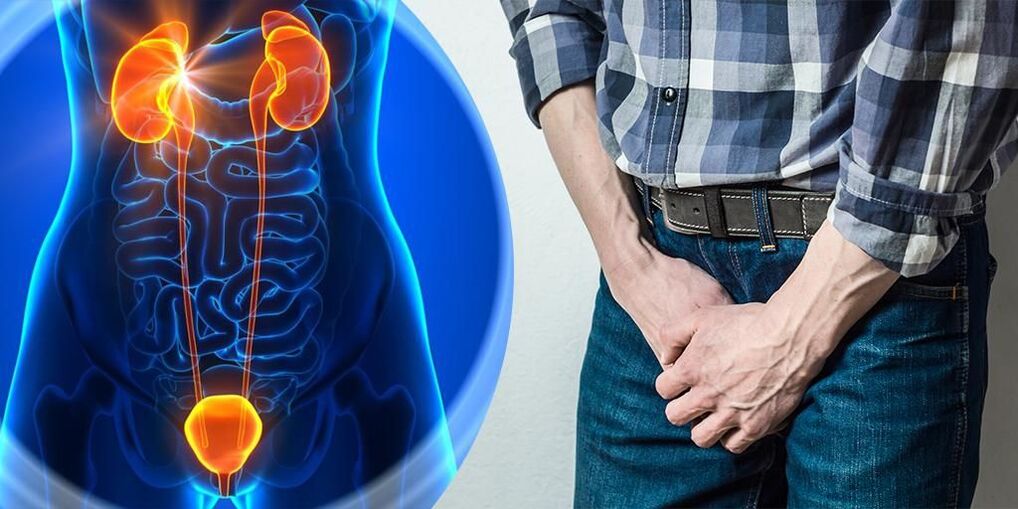
Prostatitis is diagnosed exclusively in men.This is one of the most common diseases among the diseases of the male reproductive system;4 out of 5 men have experienced symptoms of prostatitis at least once in their life.
Most often, men aged 20-40 years at the peak of their sexual activity are susceptible to prostatitis.Chronic prostatitis is diagnosed in every 10 men.It is characterized by periods of exacerbation and remission and masquerades as a number of other diseases.
Symptoms of chronic prostatitis
Symptoms of chronic prostatitis include the following:
- Discomfort and pain in the lower abdomen, with periodic cramps that do not go away for a quarter or longer.Pain can occur in the lower back, legs, scrotum and anus.It becomes especially painful when you urinate and defecate.
- Penile erection worsens and sexual desire weakens.First, premature ejaculation develops and over time, on the contrary, ejaculation practically does not occur;this becomes very difficult to achieve.
- Urination becomes painful and incomplete.There is always a feeling of incomplete emptying of the bladder.
- A man's quality of life deteriorates significantly.
There are 2 types of chronic prostatitis: bacterial and bacterial.
Bacterial (infectious) prostatitis occurs with a continuous alternation of acute exacerbations and remissions, while the prostate secretion contains infection and bacteria.
In this case, nearby organs can also be affected, such as the urethra, bladder neck and vas deferens, which is why the disease appears in different ways.An accurate diagnosis can be made after a complete examination.
Most often, the disease manifests itself as follows:
- Frequent and painful urination.
- Burning in the urethra.
- Premature ejaculation.
- Small mucous discharge from the urethra.
- Serious sexual dysfunction.
All this greatly affects the performance and mental state of a man, which leads to depression and long-term neurasthenia.
Chronic bacterial prostatitis is a disease in which no bacteria are found in the secretion of the prostate.This form is very difficult to diagnose, as evidenced by numerous reviews from men on various forums.It is also very difficult to choose the right treatment regimen.
Important
Until now, doctors have faced many unclear factors in the origin of this disease.This greatly complicates the treatment process.
Even ultrasound and laboratory tests of secretions may not show the presence of an inflammatory process.According to the recommendations of the Association of Urological Specialists, the main signs of abacterial prostatitis are identified:
- Appears in middle-aged men.
- Prolonged pain in the pelvis and groin area.
- Impaired urinary function and frequent urgency.
- Erectile dysfunction and pain during ejaculation.
- Chronic congestive prostatitis: exacerbation and remission
- Chronic congestive prostatitis is characterized by several stages of development, which are manifested by different symptoms:
- Exudative - a man feels a cutting pain in the groin, scrotum and pubic area.
- There are problems with erection and premature ejaculation.
- Alternative - the patient complains of discomfort in the groin, scrotum and pubis.
- There is a frequent urge to urinate and rapid ejaculation during intercourse.
- Proliferation - the patient notices frequent urination with a weak stream, a constant feeling of an incompletely emptied bladder.And ejaculation becomes, on the contrary, difficult and slow.
- Scar changes - at this stage, the prostate tissue begins to thicken intensively.The patient complains of discomfort in the pelvic and pubic area, frequent urge to urinate with a thin stream and incomplete emptying.Erection is very weak or completely absent, ejaculation becomes almost impossible and orgasm is weak, without vivid impressions.Prostatitis passes into the stage of chronic prostatitis of unstable remission, in which constant pain is observed and remission occurs only for a few hours.
Regarding the classification, it is customary to use the US NIH classification, which divides the disease into types: acute and chronic bacterial, chronic without signs of inflammation and congestive, as well as histological.
Factors and causes of chronic prostatitis in men
Despite the fact that some microbes of chronic prostatitis are present in the body of almost every person, only some get sick.How can the development of such a disease be explained in a particular case?
Experts determine the occurrence of chronic prostatitis not only by the presence of infection in the body, but also by the conditions that affect the development of the disease.
The most common causes of chronic prostatitis in men include:
- stagnation of blood contained in the prostate caused by a sedentary lifestyle;
- unstable sex life;
- uncomfortable and rather tight clothes;
- frequent hypothermia;
- injuries, as well as infections of various organs of the genitourinary system;
- poor nutrition;
- constant stressful situation;
- frequent drinking and smoking.
The diagnosis begins with a conversation with the patient, who must accurately and completely tell what is bothering him.The doctor must find out why the patient has developed chronic prostatitis, find out all possible causes and symptoms, how they appear.The doctor must tell you everything down to the smallest details;this will determine how accurately the diagnosis will be made and how effective and comprehensive treatment will be prescribed.
Then, you should palpate and submit the secretion for bacteriological analysis, through which you can determine the presence of infections and determine the resistance of bacteria to antibiotics.
Careful
Palpation is performed by a urologist through the rectum.This procedure makes it possible to detect the size and pain of the prostate.When palpated, hemorrhoids, adenoma or prostate cancer can also be detected.Ultrasound of the prostate will provide accurate information about the state of the organ.
Determining the level of PSA in the blood makes it possible to exclude or confirm the presence of adenoma and prostate cancer.
If the urologist suspects the presence of a tumor, he will have to submit parts of the prostate tissue for a biopsy, which will show its presence or absence.
Treatment of chronic prostatitis is a complex and time-consuming process.Today, different methods are used to treat this disease.
Treatment with antibiotics.In this case, macrolide and tetracycline antibiotics are used.
Only the attending physician can correctly choose the drug, its dosage and duration of treatment.
Medicines are usually taken for 10-15 days.After which repeated tests are done, based on the results of which the doctor will determine if the patient has recovered or if additional treatment is required.
Prostate massage is necessary so that prostate secretions do not stagnate and microcirculation occurs.This contributes greatly to a quick recovery.
However, massage is prohibited for acute prostatitis, hemorrhoids and rectal fissures.
Massage is usually prescribed as an adjunctive therapy to antibiotic treatment.
Physiotherapy is prescribed to improve the condition of the prostate tissue, thereby speeding up the healing process.
Laser therapy and ultraphoresis are used for treatment.The use of mud and enemas with mineral waters rich in hydrogen sulphide are also effective.
Herbal medicine is used as an additional stimulus for the patient's recovery and is always used in combination with other methods.
In some cases, surgical intervention may be indicated if the urethra is severely narrowed or the presence of abscesses or prostate adenoma is detected.
Important
Diagnosis and treatment must be carried out in a medical institution under the constant supervision of qualified doctors.
By consulting the doctor in time, you can achieve a quick cure.Once treatment begins, long-term remission will be observed.We can talk about complete recovery when all symptoms of the disease disappear and laboratory tests show good results.
The most popular questions from patients about chronic prostatitis
How to cure chronic prostatitis with folk remedies quickly and effectively?
Treatment can be carried out using folk remedies.In folk medicine, the most popular is the use of infusions of chamomile, yarrow and sage.These micro enemas very well relieve the inflammation that occurs in the prostate gland.
To prepare such a micro enema, take two spoons of chamomile and pour 100 grams of the herb.boiling water For treatment, you can also use horse chestnut peel, which is filled with alcohol and kept for 10 days in a dark place.
A decoction of onion also helps.You need to finely chop two large onions and pour boiling water into a half-liter jar.The jar is wrapped with a towel and left to brew for 2 hours.Then, every hour you need to drink 50 grams of decoction.
How to cure impotence with chronic prostatitis?
Impotence can be cured at home if a number of measures are followed.
It is necessary to choose suitable drugs that will help fill the cavernous bodies of the penis with blood.But before that, a consultation with a urologist is required.
It is necessary to adjust your diet and go on a diet.You should not eat fatty foods or foods that lower testosterone.You should eat porridge and lean meat, drink juices and green tea.
Also, don't forget about physical activity.Walking and jogging in the fresh air are very effective in this regard.You should also move your legs.This stimulates contraction of the muscles of the anus and perineum.
How long does it take to treat chronic prostatitis and how to get rid of it forever?
Antibiotic therapy lasts 1-3 months, depending on the advanced stage of the disease.If necessary, additional treatment with small doses of antibiotics may be prescribed.Lipophilic antibiotics cope best with this task.
To forget this problem forever, you need to change your lifestyle, eat right, avoid hypothermia and give your body rest.
Why is chronic prostatitis dangerous?
Chronic prostatitis is characterized by sharp exacerbations of the disease, which are replaced by remissions.When the pain subsides, it becomes easier and the man decides that he can cope with this problem himself, instead of quickly turning to a urologist.However, the delay will not help here, since with each aggravation the inflammation will increase.
Inflammation can affect nearby organs, leading to cystitis, pyelonephritis and vesiculitis.As a result, a man may develop infertility.
What antibiotics should I take for chronic prostatitis?
A number of penicillins are often used.Tetracycline antibiotics are often prescribed for mycoplasma and chlamydia.
Fluoroquinolones are very effective and penetrate well into prostate tissue.Macrolides accumulate well in the tissues of the prostate gland and quickly remove toxins.
Is it possible to have sex with chronic prostatitis?
If the disease is caused by an infection, then it is better to abstain from sex in order not to infect the partner.Although you can use a condom.It is simply necessary to have sex, because when you wake up, blood rushes to the prostate gland and it begins to shrink.Also, during ejaculation, the pelvic muscles contract strongly, which is considered a good self-massage.
Prevention of chronic prostatitis in men and its features
Prevention of chronic prostatitis in men involves a healthy lifestyle and daily exercise.You can constantly tense and relax your scrotum from time to time.
Every time you urinate, stop the flow a little, this way the bladder sphincter will harden.Such high-quality exercises will allow blood to circulate well through the veins of the prostate, as well as strengthen metabolic processes in the body.